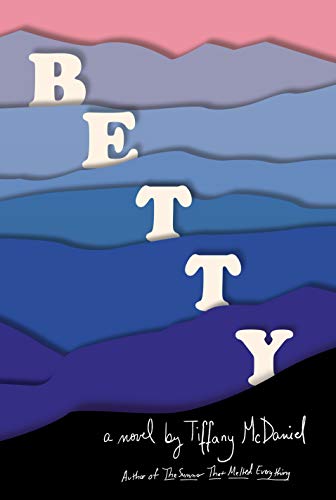
I find that some of the best writing teachers are other writers. After she invited me to review her latest novel, BETTY, Tiffany McDaniel kindly offered to contribute some wisdom to this blog. In this interview, she talks about how her connection to her Cherokee roots informs her writing, and how she drew on her personal mythology to add authenticity to BETTY. I think this is a must-read for anyone who is writing their memoir. BETTY is on sale now.
Thanks for this chat! In BETTY, you drew a lot from Cherokee mythology. How did this affect your process, and how did it benefit your story?
Writing BETTY was a journey not only through my family history, but a journey to grounding my own identity and finding myself. To me, that is the beautiful part of opening a family history. We get to learn where it is we have come from, and how all those paths merged into one. BETTY is inspired by my mother Betty’s life. For the book, I conducted Q&A sessions with her, her siblings, and their mother Alka. Landon died over a decade before I was born, so I shaped his character out of those memories and stories they shared with me. From the time I was a little girl, there were things I already knew about the maternal side of my family.
Mom made sure to raise me and my sisters on the knowledge of our Cherokee heritage and drawing on that Cherokee mythology was part of my process in writing BETTY. Growing up, my mother would pass down her father Landon’s stories and his teachings. Papaw Landon grew up in a house with several generations of his family. The elders only spoke Cherokee. But Papaw was of a generation where he had to speak not only the language of his people, but the white man’s English, too, because that was the world he was entering.
What became the universal language in their house was storytelling. Indigenous cultures have always used storytelling not only as a way to entertain, but as a way to speak to their origins, their culture, their wisdom, and their identities. The stories became the Cherokee and many other Native American tribes’ oral history that they passed forward to each new generation.
Betty is based on your mother. How did your family mythology – the stories, songs and poems passed down through generations – affect the story?
The poem, My Broken Home which starts out the book, is a poem my mother Betty wrote for this publication. Hers was a family of artists. She writes poetry, her father told stories, my aunt Fraya was a singer, my other aunt Flossie an actress, and Trustin was a visual artist. I grew up around these folks, so I used my experiences with them to craft the mythology I thought they would speak of. In the case of Fraya, I wrote songs for her that I felt she would have sung about her experiences.
In the case of my mother Betty, who wrote poetry, I wrote her in the book to be writing down the stories and secrets she was told, only to then bury them into the earth, hiding them. When she spoke about her life in those sessions, about the secrets she held on to, I saw her as someone who was burying into her own self, digging holes into her soul to hide these secrets. I wanted to see the physical act of this. When writing a family story, you must wade out into the water of that history, collect the ripples, back to the river’s edge.
For memoirists, it can be challenging to include stories about things that paint people in a bad light. How did you resolve this while writing Betty?
As I did the Q&A sessions with the women in my family, I uncovered a painful past for them. I understood that doing these sessions one must be delicate and supportive for those victims speaking about their abuse. My mamaw Alka said she never spoke of her abuse as a child because she thought it was what happened in every family. When both your mother and your father are part of that abuse, you have no other adult in your life to steer you to safety.

As an adult, Mamaw Alka supported victims telling their stories, because if there had been someone in her family or her community who spoke openly about these things when she was a little girl, it might have saved her. So as an adult, she hoped that speaking about what had happened to her might save another child from the same fate. My aunts, too, wanted their stories told. And in that process, as a writer I understood and believed their stories. In that understanding, you know there is going to be some who are painted in a bad light. But you can’t have a story like this without the villains.
I think now of those bullies my mother faced. Coming of age with brown skin in predominantly white communities, my mother was called racial slurs and verbally attacked by not only her classmates, but her teachers as well. My papaw Landon was a man who was beaten up just because of the color of his skin. We can’t share these stories unless we acknowledge the people who committed these ill deeds. You have to be unafraid to fill the page.
We can’t share these stories unless we acknowledge the people who committed these ill deeds. You have to be unafraid to fill the page.
Tiffany McDaniel
Why do you think it is important to include folklore and local mythology in contemporary fiction?
It keeps those stories alive for the next generation. I think if I hadn’t been writing this book, these stories and secrets would have died with them. To include in this case the mythology and history of the Cherokee people, you introduce readers to things they might not have known before. Few people know the Cherokee society was a matriarchal and matrilineal one. They celebrated women as leaders and thinkers. Because my papaw Landon had been raised by strong women, they instilled in him that women are to be seen as equal contributors to society.
When we reflect back on the folklore and mythology of the societies and cultures who first laid claim to this land, like the Cherokee, then we are celebrating and acknowledging their importance today. I’m so honored by my Cherokee heritage, and I use that universal language of storytelling to uplift my mother’s and my papaw’s experiences of what being Cherokee meant to them in their time and place. I wanted to position my words on the importance of not just the history of the generations before me, but my love for them as well. And in that love, the pen is brave.
I wanted to position my words on the importance of not just the history of the generations before me, but my love for them as well. And in that love, the pen is brave.
Tiffany McDaniel

Tiffany McDaniel is a novelist, poet, and visual artist born and raised in Ohio. She is the author of The Summer That Melted Everything and BETTY.
All images belong to Tiffany McDaniel.
I love the cover for this book, it’s so cool! I also love that the author used her culture’s mythology and folklore in writing her mother’s memoir. Sounds like a really interesting book! Thanks for sharing!